Why AI Content Loses Customer Trust
Marketing Strategy, AI Content, Customer Trust
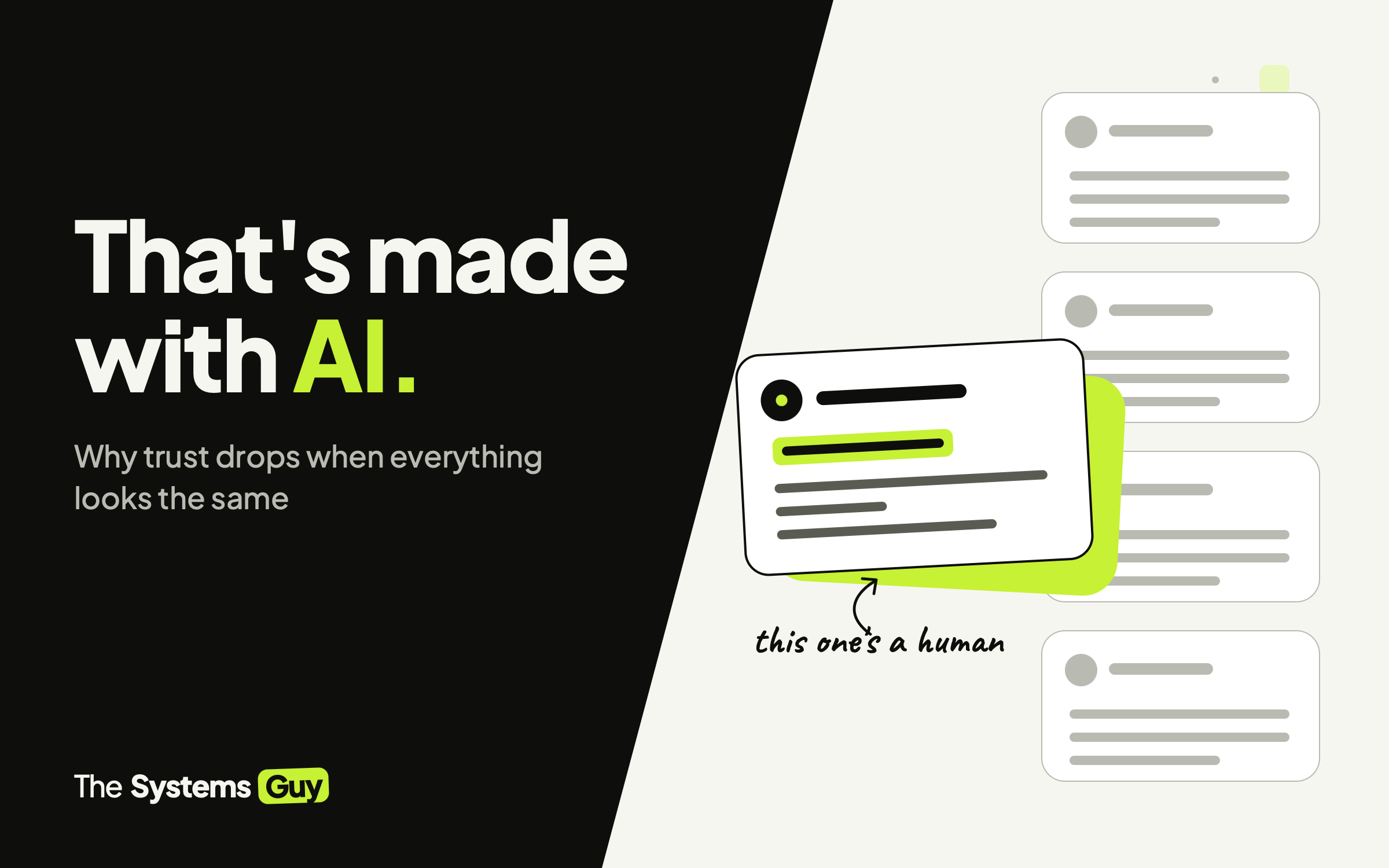
“That’s Made with AI” – Why We Lose Trust When Everything Looks the Same
I use AI. You probably do too. In fact, almost everyone in business now leans on AI for messages, images, and even full websites. Yet the more I scroll, read, and click, the more often I catch myself thinking, “That’s made with AI” – and in that moment, I feel my trust drop.
If we’re all using the same tools, why does so much AI-shaped content make us hesitate instead of helping us buy, enquire, or take the next step?

I Use AI Too – So Why Am I Suspicious of AI Content?
Let’s start with the obvious: I use AI every day at The Systems Guy. AI helps outline ideas, summarise research, draft variations of copy, and even suggest funnel improvements based on patterns in customer behaviour. Used well, it’s a powerful assistant, not a replacement for thinking.
And everyone pretty much does now – your competitors, your suppliers, your team, and likely your customers.
That’s not the problem. The problem is what happens when we look at a LinkedIn post, a sales email, a set of website headlines, or a perfectly polished hero image and instantly recognise the “AI gloss” on it. Instead of feeling reassured, we quietly become cautious. We ask ourselves:
Did someone who understands this business write this, or did they just press “generate”?
Is this based on real experience and data, or generic internet averages?
If they’ve automated the message, have they also automated the care?
That tiny pause is where trust starts to leak out of your customer acquisition funnel.
The “I Can Tell This Is AI” Moment: Messages, Images, and Websites
When I work with clients, I deliberately look at all the messages, images and websites they use to attract and convert enquiries. Email sequences, landing pages, follow-up messages, social posts, ad creatives – the whole system.
Increasingly, I can spot AI in seconds, and so can your prospects, even if they can’t articulate why.
Here are some common tells:
Messages that read like they were laid out with a ruler – every paragraph the same tidy length, three or four lines in a row. Real humans mix short, punchy lines with longer thoughts; AI often turns everything into uniform blocks.
Images that lean on clever formulas instead of real scenes – “It’s not just plumbing, it’s peace of mind” layered over yet another generic office or showroom shot. They look slick, but they don’t show your actual people, place, or process.
Websites that love neat contrasts and buzzwords – “In today’s competitive landscape…” followed by “Simple. Smart. Scalable.” or “Fast. Reliable. Done.” It sounds dramatic, but says very little about how you really work.
“That’s Made with AI” → “I’m Not Sure I Believe This”
When we think “that’s made with AI”, we’re not really judging the tool. We’re judging the effort, the care, and the signal behind the content.
Our brains are asking: did someone invest attention here, or did they automate their way through a crucial trust-building moment?
That’s why we lose trust. Not because AI is inherently bad, but because:
AI tends to smooth out the edges – the very edges that signal “this is real, this is us, this is how we actually talk and work”.
Overused AI phrasing creates sameness – and sameness is the enemy of differentiation in crowded markets.
When everything looks and sounds like AI, we subconsciously assume the underlying service is also “average”, not expert.
💡 Pro Tip: If your copy could be pasted onto a competitor’s site without anyone noticing, it’s not just generic – it’s silently eroding trust.
Why Our Brains Don’t Trust AI-Shaped Content
So, why does this happen? Why do we trust a slightly imperfect human message more than a flawless AI paragraph? There are a few psychological reasons that matter for your funnel performance:
We look for signs of effort. When a founder records a short, unscripted video or writes an email that clearly references real conversations, we feel effort and intention. AI can help draft, but if it removes all signs of effort, it also removes a key trust signal.
We crave specificity. Real businesses have specific stories, numbers, and language. “We helped a client add £480k in annual revenue by fixing one follow-up sequence” lands very differently from “We help you grow your revenue with powerful strategies.”
We notice small human quirks. A turn of phrase you always use, a slightly blunt sentence, a local reference, a niche analogy – these are hard for AI to fake consistently, but easy for humans to recognise as genuine.
When AI removes those elements, your funnel may still “work” mechanically – leads come in, emails go out – but the warmth, confidence, and credibility that move enquiries to “yes” start to leak away.
Using AI Without Losing Yourself (or Your Best Customers)
At The Systems Guy, I don’t tell clients to stop using AI. I help them contain it. AI is brilliant for:
Drafting first versions of content so you’re never starting from a blank page
Turning your own notes, transcripts, and data into structured copy or summaries
Generating multiple angles or subject lines you can then refine and humanise
But the final 20–30% of the work – the part that actually builds trust – should be human. That means:
Injecting your own stories, examples, and client outcomes into AI-drafted copy
Editing for your real tone of voice, not the generic “professional” voice everyone else uses
Checking every claim against your actual delivery and data so your promises are concrete, not wishful
Key Takeaway: Let AI speed up the “what could we say?” stage – but keep humans in charge of “is this true, specific, and ours?”.
Where AI Overuse Leaks Trust in Your Funnel
From a funnel perspective, AI overuse usually shows up as subtle but consistent drop-offs:
Strong click-through on ads or posts, but weak enquiry form completion because the landing page feels generic and interchangeable.
Good lead magnet downloads, but low reply rates to follow-up emails that sound like every other “nurture sequence” on the internet.
Plenty of booked calls, but high no-show rates because prospects don’t yet feel a real connection to you or your team.
When I audit a client’s system at The Systems Guy, I’m not just looking for technical gaps. I’m looking for trust gaps – the points where a prospect is likely to think, “This feels automated; I’m not sure how real this is,” and quietly step away.
Bringing Trust Back into an AI-Saturated Market
You don’t need to abandon AI to rebuild trust. You do need to be more deliberate. A few practical shifts:
Start with real inputs. Feed AI your own case studies, customer language, call transcripts, and numbers. Let it work from your reality, not from generic internet patterns.
Keep a “human layer” at key touchpoints. Your homepage hero, core sales emails, proposal templates, and onboarding messages should be unmistakably you, even if AI helped in the background.
Audit for sameness. Periodically review your messages, images, and websites with one question in mind: “If I didn’t know this was ours, would I still recognise us in it?”
Ready to Find and Fix Your Trust Leaks?
AI is here to stay, and used well, it can make your marketing faster and more efficient. But if your prospects are quietly thinking “that’s made with AI” when they see your messages, images, and website, you’re paying for attention that never fully converts into belief – or into business.
At The Systems Guy, I combine funnel strategy, technical build, and a clear-eyed view of how AI actually lands with real people.
The goal isn’t just more leads; it’s trusted leads – enquiries that stay warm, show up to calls, and feel confident choosing you over another AI-polished competitor.
If you suspect parts of your funnel feel “AI-shaped” rather than you-shaped, now is a good time to look under the hood. Let’s find where trust is leaking out of your customer journey and rebuild the messages that matter most.
Call to action: Book a Free Discovery Call to find out where enquiries go cold, understand how AI is helping or hurting your funnel, and start fixing the points where “that’s made with AI” quietly turns into “I’m not sure I believe this.”